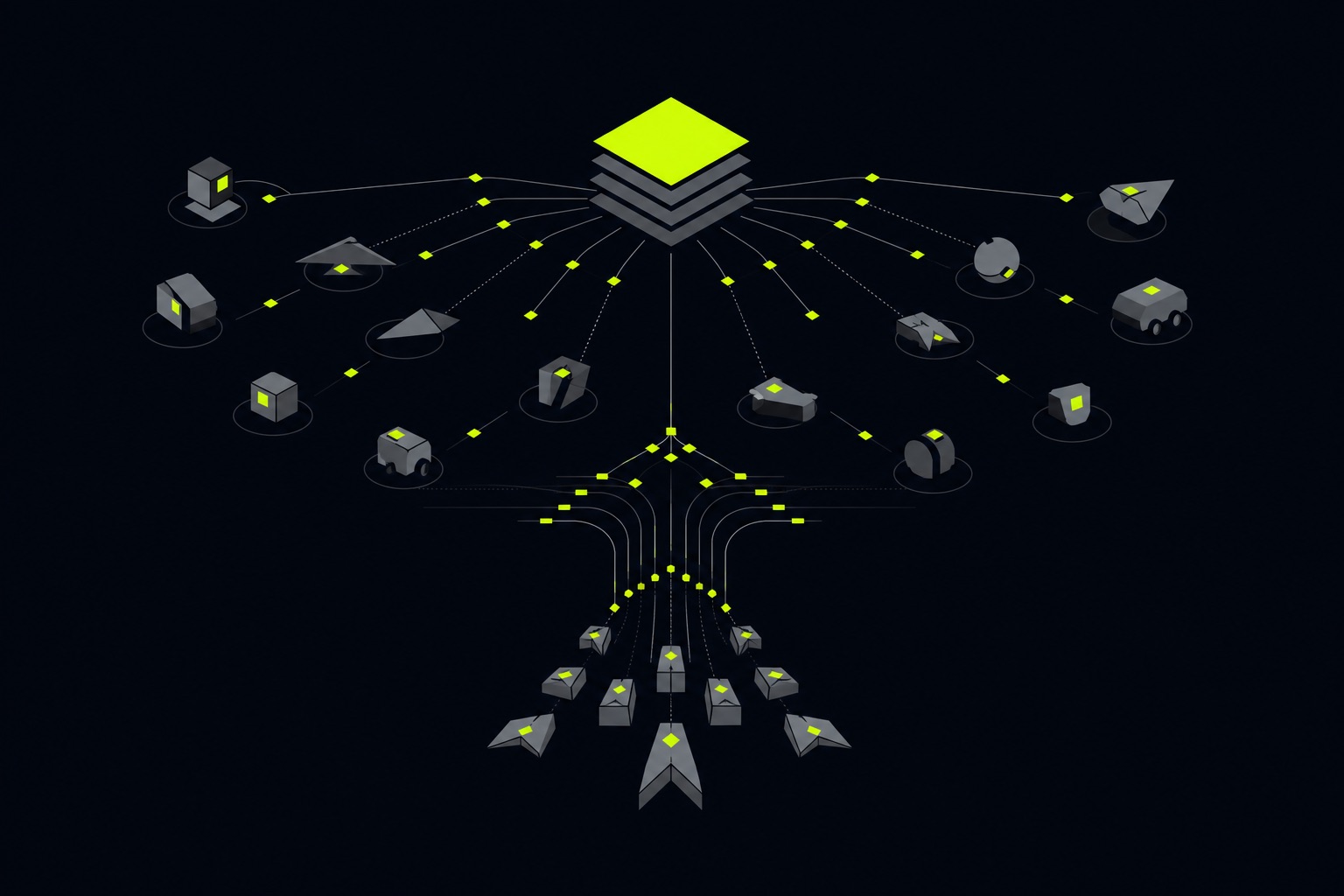
Running agent fleets in production: what it actually takes
Going from one agent to a fleet in production isn't a prompt change. It's four engineering layers: context, orchestration, observability, and an operating model your devs run.
tsukumo
The short answer
Running a fleet of AI agents in production takes four engineering layers, not a better prompt: context the agents can trust, orchestration so they don't collide, observability so you operate on evidence, and an operating model your developers actually run. Skip any one and the fleet is expensive, unreliable, or quietly abandoned.
Short version: one agent doing a task is a script. A fleet doing real work in production is a system, and it needs four things the demo never shows: context the agents can trust, orchestration so they don't collide, observability so you can run them on evidence not faith, and an operating model your developers actually run. Skip any one and the fleet is expensive, unreliable, or quietly abandoned. Here's what's really involved.
An agent is only as good as what it knows about your codebase. At fleet scale, "let it read the repo" is both expensive (every agent, every session, re-deriving the same things) and wrong (it picks stale or duplicate docs). You need a context layer that serves the current, canonical answer cheaply and on demand. Get this right and agents are fast and correct; get it wrong and you're paying premium tokens for confident mistakes. We hit this ourselves and built trovex for it; the version we run does a doc lookup at about 60% fewer tokens than letting an agent re-read the repo. That's the whole game at fleet scale: the same lookup, many times a day, across many agents.
Two agents editing the same area, or duplicating each other's work, is worse than one agent going slower. A fleet needs coordination: who owns what, in what order, how work is split and merged, what happens when two agents disagree. This is the part teams underestimate most, because with one agent it doesn't exist, and with five it's the whole game.
We learned this the embarrassing way. Early on we had two agents pick up adjacent tickets that both touched the same router file. They didn't know about each other. One opened a branch and started editing; the second branched off an already-stale main, rewrote half the same file, and its merge landed second and silently reverted the first agent's change. Tests passed. The bug shipped. We spent an afternoon bisecting our own fleet. What fixed it wasn't a smarter model. It was boring coordination: a file-level lock so two agents can't hold the same path at once, a rule that every agent rebases before it merges, and an owner that hands out tickets so two agents never get adjacent work in the same window. Dull. It's also the difference between a fleet and five agents fighting over a repo.
Where does your team actually stand on this? A short agent-ops assessment is the low-risk way to find out.
You cannot operate in production what you cannot see. For a fleet you need to know, in close to real time: what each agent did, what it cost, where it failed, and whether the output met your bar. Without this, you're trusting a black box with commit access, which no serious team will do for long. With it, agents become a measurable production system you can tune. The bar is low and most teams still miss it: if you can't answer "what did agent #3 do last night and what did it cost," you don't have observability, you have hope.
The hardest layer isn't software. It's people. A fleet is operated, by developers who've learned to set goals and guardrails, review at the right altitude, and intervene when needed, instead of typing every line. That's a real skill shift, and it only sticks if the framing is straight with them: the devs are the operators, the gains are theirs, and the agents don't replace them. Teams that skip this get tools nobody trusts and everybody routes around.
Look at what's missing from this list: clever prompts, a bigger model, more seats. Those help at the margin. The fleet stands or falls on the four layers above, and they're ordinary, demanding production engineering. Good news, really. It means the capability is buildable, repeatable, and yours to keep. It's also why "buy licenses and hope" doesn't get a team there.
We run our own agent fleets in production to ship our software, and we built the four layers (context, orchestration, observability, the operating model) because we needed them. When we work with your team, we install that same stack on your environment and standards, and train your developers to operate it, so the capability stays after we leave.
If you're trying to get from one agent to a fleet that actually runs in production, that's the work we do.
A short agent-ops assessment, no commitment. We tell you where the fleet would break first.
Find out which of the four layers your team is missing
What's the difference between one agent and an agent fleet?
One agent doing a task is a script. A fleet is a coordination problem: several agents working in parallel on different parts of the codebase without colliding or duplicating work. The jump from one to many is mostly orchestration and observability, not a bigger model.
Why do agent fleets fail in production?
Usually one of the four layers is missing. Most often it's observability (running on faith instead of evidence) or the operating model (developers never learned to operate agents, so the tools get routed around). A missing context layer makes agents expensive and confidently wrong.
Do you need a bigger model or better prompts to run a fleet?
No. Those help at the margin. The fleet stands or falls on context, orchestration, observability, and an operating model your devs run. It's ordinary production engineering, which means it's buildable and yours to keep.
Can buying more Claude or Copilot seats get us to a production fleet?
Seats give your team model access. None of the four layers comes in the box. Crossing from copilot to a running fleet is an operating problem, not a license problem.